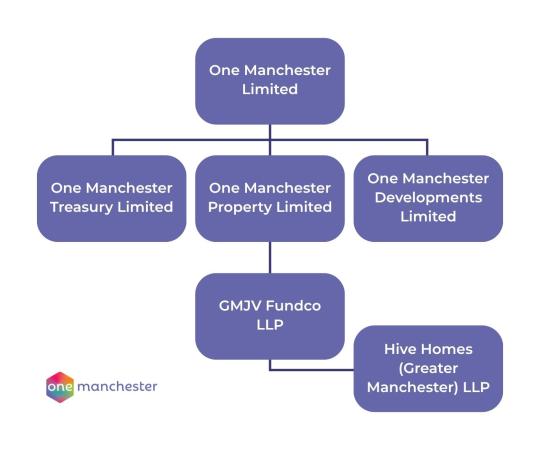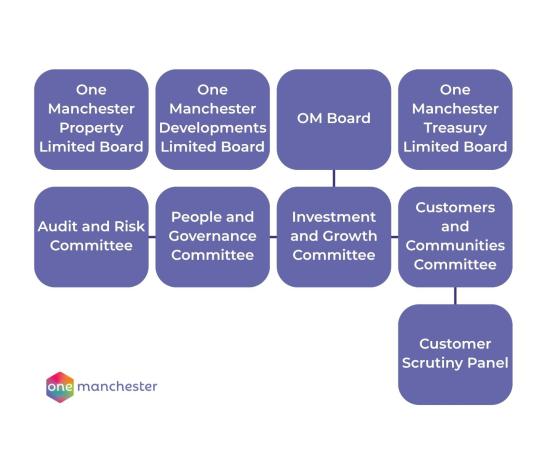

OML Delegation Framework
Illustrating how decisions are spread across multiple areas to ensure accountability
Delegation Framework
Purpose and scope
The Framework clarifies which decisions are reserved to the Board and which are delegated to subsidiaries, committees, the Chief Executive, Leadership Team, officers and other authorised individuals. Its purpose is to ensure clear accountability, appropriate authorisation, and effective day-to-day management of One Manchester’s operations.
The document applies to Board members, the Chief Executive, officers, employees, volunteers, consultants and others employed by One Manchester. It also applies to One Manchester as the parent company and its subsidiaries. Where there is any conflict, One Manchester’s constitutional Rules take precedence.
Governance and decision-making
The Board retains ultimate responsibility for the strategic leadership and control of One Manchester. It may delegate authority to committees, subsidiary Boards, the Chief Executive and officers, while retaining certain matters for Board approval only. The Framework is intended to balance Board-level strategic oversight with operational flexibility.
The Board’s committees include:
- Audit & Risk Committee
- People & Governance Committee
- Investment & Growth Committee
- Customers & Communities Committee
These committees operate across One Manchester and its subsidiaries, with their terms of reference and standing orders included in the appendices.
The Chief Executive is delegated all powers except those reserved to the Board, subsidiary Boards or committees. The Chief Executive may sub-delegate to Executive Directors and other colleagues, and is responsible for ensuring delegations are exercised effectively, within approved policies, budgets and strategic objectives.
The Leadership Team is responsible for implementing decisions made by the Board, subsidiary Boards and committees. It also has authority to approve non-material amendments to Board- or Committee-owned policies outside the formal review cycle, provided these do not change policy intent, delegated authority, statutory obligations, governance arrangements or risk appetite. Such amendments must be recorded and reported to the relevant Board or Committee for information.
Urgent decision-making
The Framework provides procedures for urgent decisions that cannot wait for a scheduled Board, subsidiary Board or committee meeting. Depending on the relevant decision-making forum, authority may rest with the Chair of the Board, Chair of a subsidiary Board, Chair of a committee, or the Senior Independent Director if the relevant Chair is unavailable.
Before an urgent decision is made, relevant members must be consulted where reasonably possible, provided with relevant information, and given an opportunity to comment. A formal record must be kept, and urgent decisions must be reported to the next available meeting.
Role of the Company Secretary
The Company Secretary has a central role in maintaining governance controls. Responsibilities include:
- Supporting interpretation of the Framework
- Maintaining the annual calendar of Board and committee meetings
- Acting as custodian of the company seal
- Maintaining records of sealed documents
- Keeping registers of authorised signatories and relevant disposals
- Supporting urgent decision records, waivers, breaches and governance reporting
Financial Regulations and financial authority
The Financial Regulations form a key part of One Manchester’s governance and financial control framework. The Chief Executive is responsible for ensuring sound Financial Regulations are developed, approved and implemented. The Audit & Risk Committee approves the Financial Regulations, which are reviewed annually.
The Framework sets out delegated financial authority limits for approving payments. Key thresholds include:
- Payments above £5 million require approval by two Non-Executive Directors.
- Payments above £2 million require approval by one Executive Director and one Non-Executive Director.
- Payments up to and including £2 million may be approved by two Executive Directors.
- Payments up to and including £1 million may be approved by an Executive Director.
- Unbudgeted expenditure above £250,000 requires Board approval.
Unbudgeted expenditure is defined as new, unforeseen expenditure, rather than general overspends on existing budgeted activity, which are managed through quarterly Board performance reporting.
Contracts, legal documents and sealing
The Framework requires appointments of contractors, suppliers and consultants to follow procurement and tendering procedures. Contracts above £50,000 must be recorded in the Assets and Liabilities Register, and all officers are responsible for informing the Executive Director of People & Governance when such contracts are entered into.
Execution of agreements is reserved to Board members, the Company Secretary, members of the Leadership Team, or others authorised by the Board. The Company Secretary maintains the register of authorised signatories and oversees the use of the company seal.
Procurement
Procurement must be undertaken in line with One Manchester’s Value for Money Strategy, Procurement Strategy, Procurement Policy and applicable statutory requirements, including the Procurement Act 2023 and relevant procurement regulations.
The document sets out procurement thresholds for goods, services and works, including when quotations, competitive tendering, Contracts Finder publication, or full formal tender processes are required. Contracts above £10,000 must be entered into the contracts register.
The Leadership Team may approve tender lists within their directorates, and tender openings must be witnessed and recorded. The Chief Financial Officer prepares an annual report to the Board on approved suppliers.
The Framework also sets out circumstances where tendering procedures may be waived, including exceptional circumstances, recent competitive exercises, negotiated schedules of rates, contract renewals, framework arrangements, consortium arrangements or extensions to existing contracts. Waivers must not be used to avoid competition or for administrative convenience and are reported annually to the Audit & Risk Committee.
Social value, modern slavery and procurement ethics
The Framework emphasises One Manchester’s commitment to social innovation and social value. Budget holders and commissioners must consider wider social, economic and environmental outcomes when procuring goods and services, not simply the lowest price.
The document also confirms One Manchester’s commitment to preventing modern slavery and human trafficking within its activities and supply chains. Relevant supporting documents include the Anti-Slavery and Human Trafficking Policy, Transparency Statement, Procurement Strategy, Value for Money Strategy and Social Value Policy.
Treasury management
The Chief Financial Officer is responsible for preparing and reviewing the Treasury Management Strategy. The Strategy is approved by the Board every two years and reviewed annually, with scrutiny by the Audit & Risk Committee.
Treasury responsibilities are clearly allocated, including approval of the Treasury Strategy, borrowing and investment arrangements, interest rate hedging, treasury transactions, maintaining records of borrowing and investments, and quarterly reporting to the Board.
Risk management, IT, insurance and insolvency
The Board is responsible for developing and maintaining a Risk Management Framework, including a Risk Management Policy, risk appetite statement, and corporate and operational risk registers. The Risk Appetite Statement must be approved by the Board at least annually, and the corporate risk register is reviewed at each normal Board meeting.
The Chief Financial Officer is responsible for effective information technology systems and ensuring compliance with data protection legislation, including UK GDPR, the Data Protection Act 2018, Data (Use and Access) Act 2025 and PECR.
Insurance arrangements are reviewed annually, with the Executive Director of People & Governance responsible for ensuring appropriate cover, maintaining insurance records and reporting annually to the Audit & Risk Committee.
The Board is also responsible for ensuring that any Group company ceases trading if there are reasonable grounds to believe it may be insolvent, with the Chief Executive and Chief Financial Officer required to provide relevant information to the Board and regulators.
OM Board Terms of Reference and Matters Reserved
The Terms of Reference for the One Manchester Limited Board defines its membership, meeting requirements, core responsibilities, delegated authority, reserved matters and review arrangements.
The Board is a skills-based Board operating in accordance with the One Manchester Rules and Delegatory Framework. It must comprise between five and 12 Board Members, meet at least four times per year, and have a quorum of five. A majority of Board Members must be neither customers nor employees, with no more than one customer Board Member at any time. The Council is entitled to nominate one Board Member.
The Board is responsible for:
- Setting and upholding One Manchester’s vision, mission, values, social purpose and strategic objectives.
- Approving the strategic aims, objectives, Corporate Plan and key organisational strategies.
- Ensuring a positive organisational culture, with a strong focus on customers and customer safety.
- Ensuring effective leadership and executive competence are in place to deliver strategic objectives.
- Providing oversight, direction and constructive challenge to the Chief Executive and Executive Leadership Team.
- Ensuring sufficient resources are available to achieve One Manchester’s strategic objectives.
- Ensuring One Manchester operates effectively, efficiently and economically.
- Establishing and monitoring systems of delegation, internal control and risk management, including financial controls.
- Ensuring compliance with statutory, regulatory and legal requirements, the Rules and relevant governance standards.
- Monitoring strategy delivery and organisational performance against approved plans, budgets, controls and Tier 1 performance data.
- Operating openly and transparently, demonstrating accountability to customers, stakeholders and partner bodies.
- Maintaining trust in One Manchester and protecting its reputation.
- Receiving reports from committees, subsidiary boards and the Chief Executive on activities and use of delegated authority.
- Approving or overseeing matters reserved to the Board, including:
- Accounting policies and annual accounts.
- Value for Money and Procurement Strategies.
- Treasury strategy and financial sustainability.
- Rent and service charge setting.
- Colleague remuneration.
- Safeguarding.
- Health and safety, including building safety.
- Risk appetite and the corporate risk register.
- Customer voice.
- Carbon neutrality and environmental sustainability.
- Social value.
- Equality, Diversity and Inclusion.
- Approving major strategic decisions, including significant changes to management, operations, corporate structure, subsidiaries, joint ventures, mergers or stock transfers.
- Approving major contracts, expenditure and financial decisions, including significant development, regeneration, capital, IT, funding, treasury and asset disposal matters.
- Approving business plans, annual budgets, annual reports and financial statements.
- Approving unbudgeted capital or operating expenditure above £250,000.
- Establishing, overseeing and reviewing internal controls, including the risk appetite statement and internal controls assurance.
- Overseeing corporate governance arrangements, including Board and committee structure, appointments, Terms of Reference, Rules, Code of Governance and financial delegation framework.
- Appointing and, where necessary, removing key roles, including Board Members, subsidiary Board Members, the Chair, Senior Independent Director, Chief Executive, Company Secretary and external auditor.
- Approving key strategies and policies, including investment, sustainability, customer voice, EDI, social value, anti-racism, asset management, building safety, procurement, health and safety, safeguarding, risk and transparency policies.
- Setting EDI priorities and objectives, and overseeing One Manchester’s commitment to equality of opportunity, diversity and inclusion.
- Reviewing Board performance annually, including collective effectiveness, competencies and the Terms of Reference, with an independent review at least every three years.
- Managing miscellaneous reserved matters, including committee delegations, material litigation, insurance, executive remuneration policy, conflicts of interest and standards of propriety, good practice and regulatory compliance.
Audit & Risk Committee
The Audit & Risk Committee is responsible for providing assurance to the Board across audit, risk, internal controls, compliance and financial reporting matters.
Key responsibilities include:
- Overseeing external and internal audit arrangements, including auditor appointment, performance, independence, audit plans, findings and follow-up actions.
- Reviewing the integrity of financial statements, annual accounts, accounting policies, financial regulations and key financial disclosures before Board approval.
- Monitoring and reviewing internal controls, financial controls, business continuity, insurance arrangements and the effectiveness of risk management systems.
- Overseeing the Group’s risk management framework, including risk appetite, risk strategy, risk policies, principal and emerging risks, and quarterly risk reporting.
- Providing assurance to the Board on the adequacy and effectiveness of systems for managing financial, operational, regulatory and strategic risks.
- Reviewing compliance with relevant statutory, regulatory and governance requirements, including economic standards and regulatory returns.
- Overseeing arrangements for whistleblowing, fraud, bribery, anti-money laundering, cyber security, data protection and IT security.
- Reviewing and approving relevant policies and strategies, including treasury, whistleblowing, anti-fraud, anti-money laundering, IT security and data protection policies.
- Receiving and monitoring recommendations from the Customer Scrutiny Panel, including actions arising from scrutiny reviews.
- Overseeing One Manchester’s anti-modern slavery activities and reviewing the annual Anti-Slavery and Human Trafficking Transparency Statement for Board approval.
- Reviewing the Committee’s own performance and Terms of Reference annually and recommending any changes to the Board.
- Reporting to the Board on its activities, including risk-related work and assurance matters.
People & Governance Committee
The People & Governance Committee supports the Board by overseeing governance, people-related matters, remuneration, succession planning, Board and Committee effectiveness, and compliance with regulatory and governance standards.
The Committee is responsible for:
- Upholding One Manchester’s values and objectives on behalf of the Board.
- Overseeing compliance with regulatory requirements, the NHF Code of Governance, and wider good governance practice.
- Reviewing One Manchester’s corporate, Board and Committee structures.
- Supporting recruitment, advancement, retention and succession planning for Board, Committee and senior management roles.
- Developing and overseeing remuneration policy for the Chief Executive, Board and Committee Members, and staff.
- Approving key colleague and Board-focused strategies and policies.
- Ensuring accountability, transparency and stakeholder trust in governance decisions.
- Reviewing and approving Chief Executive remuneration, terms of employment, appraisal arrangements and related employment matters.
- Reviewing colleague remuneration awards and approving relevant expenses, pensions, terms and conditions, redundancy and employment-related requests.
- Overseeing Board and Committee recruitment, renewal, appraisal, training, induction and de-selection processes.
- Recommending Board and subsidiary Board appointments and re-appointments.
- Approving appointments to Committees within the Governance Framework.
- Managing or supporting Chief Executive recruitment, appraisal, grievance, disciplinary and termination arrangements.
- Approving and monitoring Code of Conduct arrangements, including conflicts of interest and declarations.
- Managing the independent triennial review of governance effectiveness and recommending resulting changes to the Board.
- Approving governance-related reporting for the Annual Accounts, including any non-compliance reporting.
- Overseeing statutory and regulatory returns, registers and compliance matters.
- Reviewing One Manchester’s Rules and recommending changes to the Board.
- Reviewing its own performance, terms of reference and the effectiveness of other Committees.
- Reporting significant Committee decisions to the Board.
- Seeking information, calling employees to meetings, and commissioning independent advice or specialist reports where required.
Investment & Growth Committee
The Investment & Growth Committee supports the Board by overseeing the investment programme, development programme and any regeneration works.
Key responsibilities include:
- Oversee delivery of One Manchester’s Growth Programme, including development, regeneration, acquisitions, disposals, land transactions and scheme approvals within delegated limits.
- Provide oversight of strategic asset management, including delivery of the Asset Management Strategy, capital programme, investment in existing homes, stock quality, Decent Homes requirements and safe, sustainable homes.
- Review, approve or recommend key strategies and programmes to the Board, including the Development and Regeneration Strategy, Growth Programme, Asset Management Strategy and Sustainability Strategy.
- Scrutinise scheme appraisals, financial viability, investment assumptions, funding priorities, post-scheme reviews, design quality and programme performance.
- Approve schemes within delegated thresholds and recommend higher-value, higher-risk or out-of-programme schemes to the Board.
- Monitor the financial, business and operational performance of growth, investment, development, regeneration and asset management activities.
- Oversee sustainability and carbon reduction activity, including delivery of the Sustainability Strategy, carbon reduction programmes and customer engagement on sustainability.
- Ensure customer views and customer voice are considered in growth, regeneration, asset management and sustainability activity, liaising with the Customers and Communities Committee where appropriate.
- Oversee joint ventures and strategic partnerships, including performance, compliance, risk management, governance, benefits and risks.
- Operate within the Group’s approved control, financial, risk management, performance and policy frameworks.
- Monitor risks relating to asset management, property investment, sustainability, procurement, development, repairs and maintenance, and strategic partnerships.
- Review its own performance and Terms of Reference annually, recommending any changes to the Board for approval.
Customers & Communities Committee
The Customers & Communities Committee provides assurance to the Board that customer voice, customer experience, and consumer regulatory requirements are actively shaping service improvement and Board decision-making. It also acts as a key link between the Board, the Customer Scrutiny Panel, customers, and resident involvement structures.
The Committee’s responsibilities include:
- Providing assurance to the Board that customer voice and consumer regulatory requirements are influencing service improvement.
- Listening to and using customer feedback from sources such as the Customer Scrutiny Panel, TSM surveys and statistics, complaints, customer journey maps, root cause analysis, councillor/MP enquiries, and consultations.
- Ensuring compliance with the Regulator’s Consumer Standards, the Housing Ombudsman’s Complaint Handling Code, and other relevant legislative requirements.
- Receiving reports and updates from the Customer Scrutiny Panel and reporting outcomes to the Board.
- Reviewing progress with the Customer Scrutiny Panel annually and recommending scrutiny reviews where further examination of significant risks is required.
- Reviewing and approving the Annual Customer Report.
- Recommending Board approval of the annual self-assessment against the Housing Ombudsman’s Complaint Handling Code.
- Monitoring customer feedback, complaints, compensation payments, and engagement with MPs and Councillors.
- Ensuring customers’ views and needs are heard and used to improve services and customer experience.
- Reviewing compliance with Consumer Regulatory Standards and recommending approval to the Board.
- Approving and monitoring the Customer Experience Strategy.
- Reviewing, recommending, and monitoring the Customer Voice Strategy.
- Monitoring relevant customer-facing strategies, policies, and action logs, including complaints and compensation policies.
- Approving significant changes to customer-facing policies, including repairs, compensation, tenancy-related, and community-focused policies.
- Monitoring key performance indicators relating to repairs, maintenance, adaptations, customer satisfaction, Tenant Satisfaction Measures, complaints, and demographic data.
- Recommending Board approval of the annual Customer Report and annual TSM Report.
- Monitoring repairs data, Healthy Homes referrals, and empty homes turnaround times.
- Reviewing tenancy experience data and trends.
- Monitoring allocations to ensure homes are let fairly and transparently.
- Monitoring work with local authorities, police, and other partners on ASB, domestic abuse, and customer support.
- Monitoring community funding, including the Thrive Fund, and wider community impact.
- Overseeing community investment and improvements to local services.
- Monitoring local training and employment initiatives for customers.
- Reviewing the Committee’s own performance and Terms of Reference annually.
- Reporting significant Committee decisions to the Board.
- Seeking information from employees, calling employees to attend meetings when required, and accessing sufficient resources to carry out its duties.
Customer Scrutiny Panel
The Customer Scrutiny Panel’s role is to advise, scrutinise and challenge One Manchester’s performance, service delivery, customer engagement and compliance with relevant consumer standards, legislation and regulatory expectations. The Panel has no delegated authority but makes evidence-based recommendations for consideration and reports through the Customers & Communities Committee, with review findings also reported to the Audit & Risk Committee and, where appropriate, the Board.
The Panel’s responsibilities include:
- Providing an independent and objective view of One Manchester’s services and compliance with the Consumer Standards.
- Undertaking and overseeing customer-led scrutiny activities in line with the Panel’s schedule of work.
- Providing constructive feedback on delivery of the Customer Voice Strategy and how One Manchester engages with customers.
- Monitoring the implementation of recommendations arising from scrutiny reviews.
- Reviewing performance information, highlighting exceptions and areas of poor performance.
- Agreeing an Annual Scrutiny Plan, with appropriate advice and guidance.
- Commenting, when requested, on strategies and policies marked for customer consultation.
- Preparing reports and recommendations that are balanced, evidence-based and informed by regulatory standards, good practice and the operating context.
- Holding One Manchester to account for deadlines linked to recommendations from scrutiny reviews.
Legal framework